
You've probably tried typing a topic into ChatGPT and hitting generate. You got a draft. Then you spent an hour editing it, researching keywords separately, uploading it to your CMS, and realizing you forgot internal links. That's AI-assisted writing. AI content generation is the full pipeline running without you.
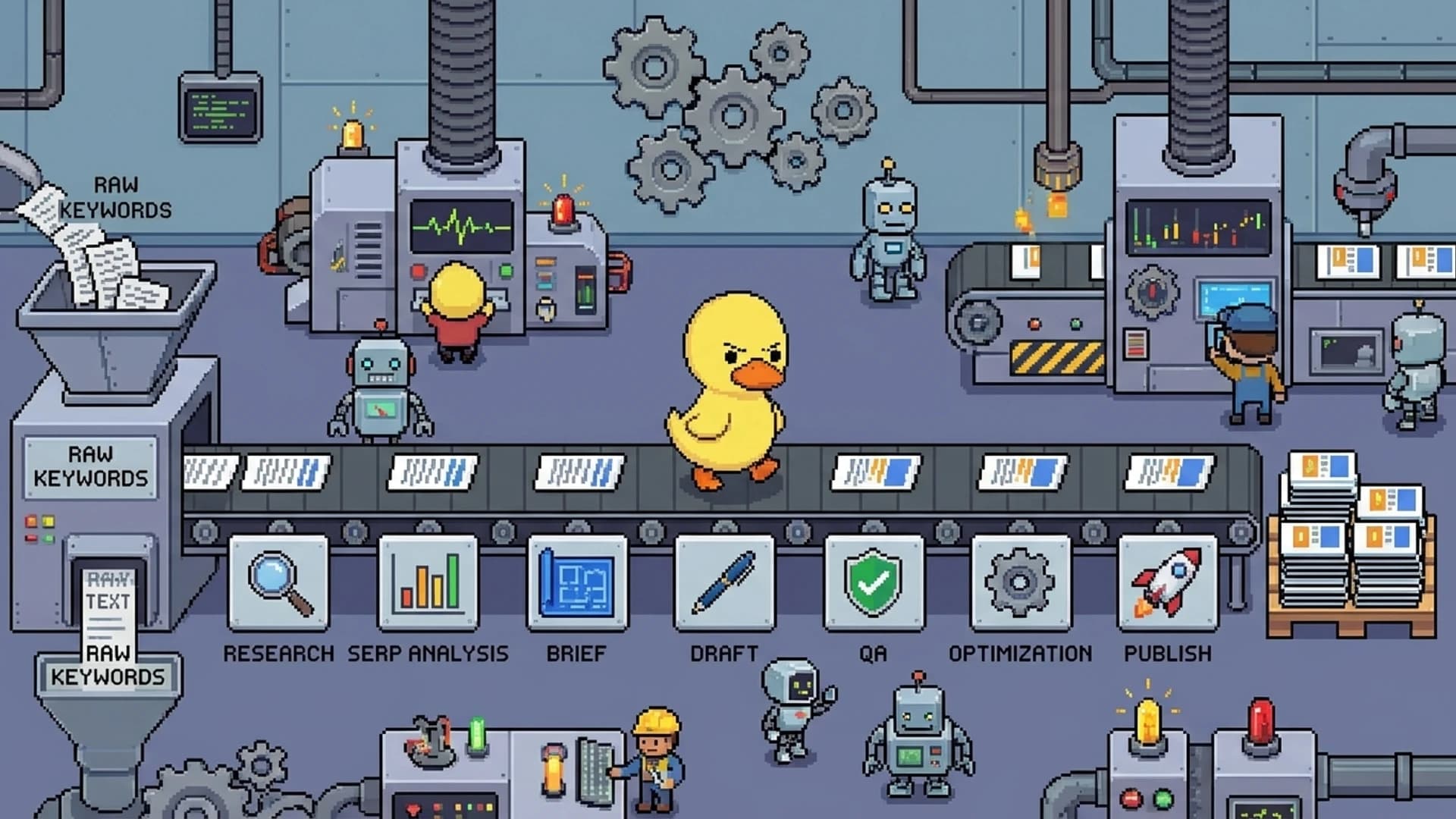
The writing was never the hard part. The system around it was. Keyword research, competitive analysis, brief creation, multi-pass QA, SEO optimization, internal linking, publishing. That's seven steps, and typing a prompt into a chatbot covers exactly one of them. When all seven run as a single automated workflow, the cost per published article drops from $350 to roughly $4.50.
AI content generation in 2026 means a full automated pipeline: keyword research, SERP analysis, brief creation, AI drafting, multi-pass QA, SEO optimization, internal linking, and publishing. Each article costs $3-8 in API costs versus $300-500 from agencies. Google doesn't penalize AI content. They penalize unhelpful content. The real competitive edge is using AI to build topical authority across entire keyword clusters, not just write individual posts.
What You'll Learn
- The difference between AI writing tools and full AI content generation pipelines
- The 7-step pipeline from keyword research to published, optimized post
- A systematic quality control framework with three automated passes
- Real cost breakdowns: $3-8 per article versus $300-500 from agencies
- How to build topical authority with AI, the strategy nobody covers
- Why Google doesn't penalize AI content, with specific data points
What is AI content generation?
Here's a simple way to think about it. You type a prompt into ChatGPT and get text back. That's AI writing. Now imagine a system that researches keywords, analyzes the top-ranking pages, writes a structured brief, drafts the article, runs quality checks, optimizes for SEO, builds internal links, and publishes. All you do is click approve. That's AI content generation.
The distinction matters more than it sounds. When most people say 'AI content generation,' they mean prompting a chatbot. But prompting skips the 90% of work that determines whether content actually ranks. Keyword selection, search intent matching, competitive gap analysis, heading structure, internal linking. None of that happens inside a ChatGPT window. A real AI content generation system handles all of it programmatically.
AI content generation vs. AI writing tools
AI writing tools like ChatGPT, Jasper, and Copy.ai handle one step: writing. AI content generation systems handle the full pipeline: research, planning, writing, QA, optimization, and publishing. Think of it this way: a writing tool is a calculator. A content generation system is an accountant.

The 7-step AI content pipeline
Every piece of content that ranks on Google goes through the same fundamental steps, whether a human or AI wrote it. The difference is speed. AI executes all seven in minutes instead of days. Here's what each step looks like.
1. Keyword research and opportunity scoring
The pipeline starts with data, not creativity. The AI agent pulls keyword data from SEO APIs and scores each one on search volume, difficulty, CPC as a proxy for commercial intent, and SERP composition. A keyword with 1,600 monthly searches, medium difficulty, and $8.48 CPC? Strong candidate. But a high-volume keyword that doesn't connect to your product is worthless. The agent scores hundreds of keywords and picks the best opportunities based on your site's current authority and topical focus.
2. SERP analysis and competitive gaps
Before writing a single word, the system looks at what's already ranking. It pulls heading structures, content depth, word counts, and the topics nobody covered. If no ranking article includes cost breakdowns or quality control frameworks, those become sections in your article. You're exploiting gaps your competitors left wide open.
3. Brief generation from SERP data
The brief is the blueprint. It includes target and secondary keywords, recommended word count, heading structure mapped to subtopics, People Also Ask questions from SERP data, and internal linking targets. A brief built from real search data produces fundamentally different content than one built from a marketer's gut feeling.
4. AI drafting with brand voice
The LLM writes the full article constrained by the brief. This isn't a generic AI dump. It follows your heading structure, hits keyword targets, writes at your brand's reading level, and mentions your product where it naturally fits without being salesy. A brand voice profile trained on your existing content turns generic AI output into something that sounds like your team wrote it.
5. Multi-pass quality assurance
This is where most AI workflows fall apart. They generate, skim, publish. A proper QA process runs three passes: structural validation (keyword placement, heading hierarchy, word count), content quality (factual accuracy, specificity, brand voice alignment), and human review. By the time content reaches you, 80% of issues are already resolved. What used to be a 45-minute editing session becomes a 5-minute approval.
6. SEO optimization and internal linking
After QA, the system optimizes meta tags, schema markup, heading hierarchy, image alt text, and URL slugs. Then it builds internal links. Both from the new article to relevant existing pages and from existing pages back to the new one. This bidirectional linking is the step that falls apart when humans do it manually. An AI agent scans your entire content library and handles it in seconds.
7. Publishing and performance monitoring
The article deploys to your CMS with proper formatting, categories, and featured image. The system submits the URL for indexation, updates your sitemap, and starts tracking rankings and organic traffic. If a piece underperforms, it flags it for a content refresh. If it performs well, it finds opportunities to create supporting content that builds on that momentum. The pipeline is a loop, not a line.

Does AI content actually rank on Google?
Yes. And this is the question that stops most people from committing. Google's official position, stated in their February 2023 guidance and reinforced in every update since, is simple: they reward helpful content regardless of how it was produced. The ranking factors are helpfulness, expertise, and user satisfaction. Not authorship method.
The sites that got hammered by Helpful Content Updates in 2023-2024 were publishing AI content without the pipeline. No keyword research. No competitive analysis. No QA. No unique insights. They used AI to scale mediocrity. That doesn't work. Using AI to scale a rigorous content process does. Sites running systematic AI pipelines are reporting organic traffic growth comparable to human-written content programs.
What gets penalized
Google penalizes 'scaled content abuse,' which means mass-producing thin, generic articles to manipulate rankings. Publishing 100 AI articles with no unique insight is the exact pattern that triggers penalties. Quality per article matters more than quantity.

See how duqky's Content Worker handles the full AI content pipeline, from keyword research to publishing, for roughly $4.50 per article.
See how it works
What AI content generation actually costs
Every article about AI content says it's 'cheaper than hiring writers.' Nobody breaks down actual numbers. Here's what a single 2,000-word SEO-optimized blog post costs through an AI pipeline, based on real production data.
- Keyword research and SERP analysis API calls: $0.25-0.70
- LLM tokens for brief generation + article drafting: $0.85-2.65
- QA passes (2-3 LLM review calls): $0.20-0.60
- Image generation (1-3 images): $0.10-0.50
- Internal link analysis + publishing automation: $0.05-0.10
- Total API/compute cost per article: $1.45-4.55
Add 7-15 minutes of your review time and the all-in cost is $10-23 per published article. Compare that to $300-500 for a freelance writer or $500-1,500 from a content agency. That's a 93-98% cost reduction. At $15 per article, you can publish 20 articles per month for $300. An agency charges $300 for a single article. That's not a typo.

Building topical authority with AI content
This is the strategy most guides skip, and it's the single biggest advantage AI gives you. Topical authority means Google recognizes your site as a comprehensive source on a specific subject. You don't build it with scattered blog posts. You build it with topic clusters: a pillar page covering a broad topic, surrounded by 10-30 supporting articles that cover every subtopic in depth, all interlinked.
Before AI, building a single topic cluster took 3-6 months. Research the pillar topic, identify supporting keywords, brief each article individually, manage multiple writers, edit everything, build internal links manually, publish over weeks. With an AI content pipeline, you can build an entire cluster in a single month. The agent handles keyword clustering, maps which articles should link to which, and ensures consistent terminology and depth across the whole cluster.
Your domain builds authority on a topic 5-10x faster than manual content operations. Google sees a site that comprehensively covers a subject with deep internal linking between related pages. This is the opposite of 'spray and pray.' It's strategic, interconnected publishing. And it's how you go from invisible to authoritative in a fraction of the time.

How to choose an AI content generation tool
The market splits into three tiers. Tier 1: general-purpose LLMs like ChatGPT and Claude. You write the prompts and manage the workflow yourself. Best if you're publishing 1-4 articles per month and already know SEO. Tier 2: AI writing tools like Jasper and Copy.ai. They give you templates and tone controls, but you still handle the pipeline manually. Best for small teams that need writing to go faster.
Tier 3: AI content agents. Autonomous systems that handle the full pipeline from keyword research to publishing. Best for SaaS companies that want to scale production without scaling headcount. Here's the thing: the tiers aren't about writing quality. A well-prompted Claude query produces text as good as any Tier 2 tool. The difference is pipeline automation. If you're publishing 10+ articles per month, the time savings from Tier 3 pay for themselves many times over.
Frequently asked questions
Frequently Asked Questions
At its simplest, you type a prompt into a chatbot and get text back. At its most advanced, it's a fully automated pipeline that handles keyword research, competitive analysis, brief creation, writing, quality checks, SEO optimization, internal linking, and publishing. You just approve the output. The writing step was never the bottleneck. The system around it was.
Yes, when it goes through a real pipeline. AI content that's researched against keyword data, written to match search intent, quality-checked for accuracy, and optimized for on-page SEO ranks just as well as human-written content. Raw ChatGPT output rarely ranks because it lacks the SEO foundation. The pipeline is what matters, not who typed the words.
Google can probably spot AI patterns in text. But they've explicitly said they don't penalize content for being AI-generated. Their spam policies target 'scaled content abuse,' which means mass-producing low-quality content to game rankings. That applies whether a human or AI wrote it. Quality is what matters.
A fully optimized 2,000-word blog post costs $1.45-4.55 in API and compute costs. Add 7-15 minutes of your review time and the all-in cost is $10-23 per published article. Compare that to $300-500 from a freelancer or $500-1,500 from a content agency. That's a 93-98% cost reduction.
AI is replacing the mechanical parts: first drafts, research synthesis, SEO formatting. It's not replacing the strategic parts: deciding what to cover, what angle to take, what insights matter. The role is shifting from 'content writer' to 'content strategist who uses AI.' Less time typing, more time thinking.
A freelancer with ChatGPT gives you AI-assisted writing. That covers maybe 20% of the pipeline. You still need keyword research, briefs, publishing, internal linking, and performance tracking. An AI content agent handles the entire system end-to-end. The difference is between a better hammer and a construction crew.

duqky's Content Worker handles the full AI content generation pipeline, from keyword research to publishing. Start with 500 free credits and see the difference a real pipeline makes.
Get started free