
Google's VP of Search said it plainly: "GEO is really just SEO." He's half right. The fundamentals haven't changed. Quality content, authority, structure. But the outputs, the metrics, and the way your buyers interact with results have changed completely. And if you're a SaaS founder allocating a limited budget between the two, "just do both" isn't a strategy. It's a cop-out.
This is the comparison that should exist but doesn't. Not the consultant-friendly "you need both" take. A dimension-by-dimension breakdown with real numbers and a decision framework based on where your company actually is right now.
GEO gets you cited in AI-generated answers. SEO gets you ranked in Google's link list. They share about 70% of the same foundation but split on inputs (prompts vs keywords), outputs (citations vs rankings), metrics, and costs. If you're pre-PMF, prioritize SEO. At scale, layer GEO. Default starting split: 70/30 SEO-to-GEO. Princeton/IIT Delhi research shows GEO-optimized content improves AI visibility by up to 40%.
What You'll Learn
- Six dimensions where GEO and SEO actually differ (not just "keywords vs prompts")
- Real cost comparison: what you're actually spending on SEO tools vs GEO monitoring
- A decision framework based on your company stage and revenue, not generic advice
- What the Princeton 40% improvement stat actually means for your content
- How to add GEO to your existing SEO workflow without doubling your workload
- Whether SEO is dead (spoiler: no, but lazy SEO is)

What's actually different between GEO and SEO
SEO is the game you already know. You target keywords, build backlinks, optimize technical elements, and fight for positions 1 through 10. The playbook is 25 years old and the tools are mature.
GEO is a different game. You're making your content get cited by AI search engines like ChatGPT, Perplexity, Google AI Overviews, and Claude. There are no positions. The AI reads dozens of sources, synthesizes an answer, and either quotes you or doesn't. You're optimizing for extraction, not ranking. For a deeper dive into GEO itself, see our complete guide to generative engine optimization.
The confusion happens because most of the underlying work is identical. Quality content, topical authority, E-E-A-T signals, clean site architecture. All of it matters for both. The Princeton/IIT Delhi study found that GEO-specific techniques improved AI visibility by up to 40%. But that improvement was layered on top of SEO fundamentals, not instead of them.
The 70/30 rule
About 70% of what makes content rank in Google also makes it get cited by AI. The other 30% is GEO-specific: direct-answer formatting, citation-worthy phrasing, and structured data that makes extraction easy. That 30% is where the work diverges.

GEO vs SEO: six dimensions that matter
Most comparisons stop at "keywords vs prompts" and "links vs citations." That's true but shallow. Here are six dimensions that actually change how you spend your time and money.
1. Input signals: keywords vs conversational prompts
SEO starts with keyword research. Terms with volume, mapped to pages. GEO starts with prompt understanding. Your buyers ask questions like "What CRM should a 10-person startup use if they need HubSpot features but can't afford it?" The AI doesn't match keywords. It understands intent and pulls from multiple sources. GEO rewards depth and specificity over keyword density.
2. Output format: ranked links vs synthesized citations
SEO gives you ten blue links. Position 1 gets about 27% of clicks. Position 2 gets 15%. By position 5, you're under 6%. It's a power law. GEO gives you a synthesized answer with 3-5 inline citations. There are no positions. You're either cited or you're not. In SEO, ranking fourth still gets you traffic. In GEO, if you're not cited, you get zero. It's binary.
3. Ranking factors: PageRank vs quotability
Google weighs 200+ signals: backlinks, speed, mobile-friendliness, engagement. AI citation engines do something different. They retrieve candidate pages using traditional signals, then the AI reads your content the way a researcher would. It's looking for clear, definitive, well-sourced statements it can confidently quote. Vague content doesn't get cited, no matter how many backlinks it has.
4. Traffic model: clicks vs brand impressions
SEO drives clicks you can track precisely in Search Console. GEO drives brand impressions. The AI cites you, but users may never visit your site. Click-through rates from AI citations are 30-60% lower than traditional search. That doesn't make GEO less valuable. Brand visibility builds trust that converts later through direct searches and word-of-mouth. But you measure it differently.
5. Content lifecycle: evergreen vs freshness-weighted
In SEO, a well-optimized page can rank for years. Some of the highest-traffic pages at Wave Connect were 2+ years old, still climbing as they accumulated backlinks. GEO favors freshness more heavily. AI engines want current answers. A 2024 article gets deprioritized when a 2026 update on the same topic exists. GEO requires more frequent content refreshes. That's a cost most comparisons ignore.
6. Competitive dynamics: defending a rank vs earning every citation
In SEO, you defend a ranking through backlinks, updates, and technical optimization. Position 1 is defensible. In GEO, citation share shifts with every query. The AI re-evaluates sources each time. Your content might be cited today and replaced tomorrow by a competitor's fresher article. There's no position to defend. You earn citations continuously through quality and recency.

What this actually costs
Nobody talks about the real cost difference. Here's what you're actually looking at as a SaaS company doing content-led growth.
- SEO tooling: $200-500/mo (Ahrefs or Semrush, content optimizer, technical auditing, Search Console)
- GEO monitoring: $150-650/mo (AI citation tracking, cross-platform monitoring, brand mention tools, schema validation)
- Combined: $350-1,150/mo in tooling alone, before content production costs
If you're a bootstrapped SaaS founder spending $3-5K/month on content, tooling eats 10-30% of your budget. The alternative: an AI SEO agent that handles both SEO and GEO optimization in one workflow. Keyword targeting, citation-ready formatting, schema markup, and content production for a fraction of the combined cost.

See how duqky's Content Worker optimizes every article for both SEO and GEO simultaneously — no separate workflows, no doubled tooling costs.
See how it works
How to prioritize: a decision framework by stage
Here's the opinionated take nobody else will give you. Instead of "do both," here's how to actually allocate your time and budget based on where your company is right now.
Pre-PMF (0-$10K MRR): 90% SEO, 10% GEO
You need traffic that converts. SEO delivers direct clicks to your site. GEO delivers brand mentions that are valuable but harder to convert when nobody knows you yet. Focus on keyword research, content production, and technical fundamentals. Your 10% GEO effort is structural. Add FAQ schema and clear answer formatting to everything you publish. Skip the GEO monitoring tools for now.
Scaling ($10K-$100K MRR): 70% SEO, 30% GEO
You have product-market fit and your SEO foundation is working. Now layer in GEO intentionally. Start monitoring AI citations. Restructure your top-performing content for extraction. Build topical clusters. Your domain authority is strong enough that AI engines are probably already citing you. The question is whether you're optimized for it or leaving citations to chance.
Growth ($100K+ MRR): 50% SEO, 50% GEO
You have significant domain authority, a large content library, and brand recognition. GEO becomes a real growth channel. Invest in original research, proprietary data, and thought leadership that AI engines preferentially cite. Track citation share as a core metric alongside organic rankings. SEO defends your existing positions. GEO expands your AI presence.
How to add GEO to your existing SEO workflow
If you already have an SEO program running, adding GEO doesn't require a rebuild. It requires a layer. Here are the specific additions.
- Audit your top 20 pages: Do they lead with direct answers? Have FAQ sections? Include unique data? Score each 1-5.
- Add FAQ schema to every article — the single highest-ROI GEO optimization, helping both featured snippets and AI extraction.
- Restructure intros — move your main answer to paragraph one. AI engines heavily weight the opening when deciding to cite.
- Include original data wherever possible — survey results, benchmarks, customer stats give you a citation edge over repackaged info.
- Build topical clusters — both SEO and GEO reward comprehensive coverage of subtopics around a core theme.
- Monitor monthly — check AI citations, track which pages get cited, look for patterns, and double down on what works.
The efficiency insight
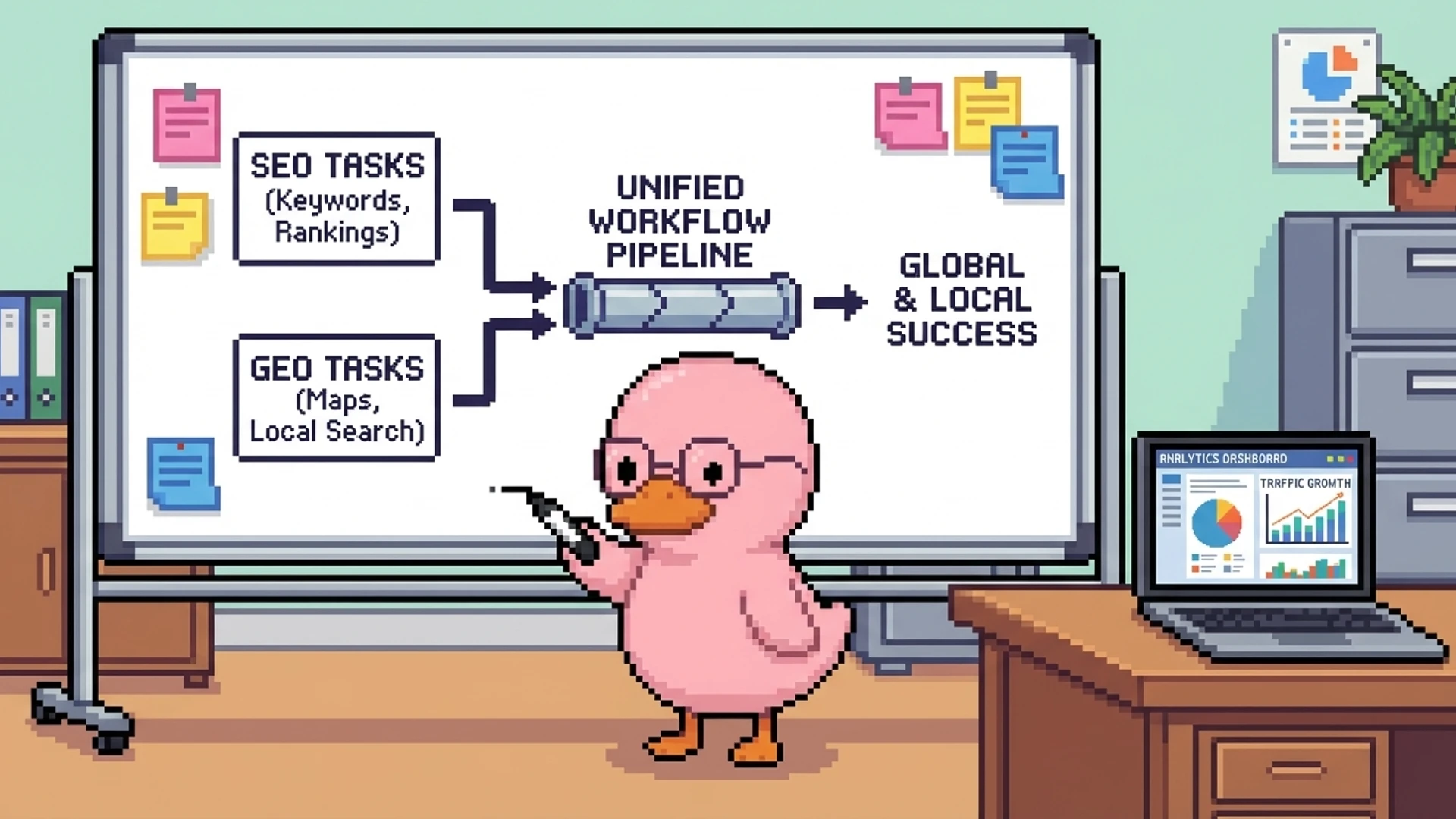
Notice the overlap. Content creation, performance tracking, iteration. Running SEO and GEO as separate programs doubles your work for no reason. A unified workflow optimizes every piece for both channels at once. This is why <a href="/blog/what-is-geo">understanding what GEO actually is</a> matters. It's not a separate discipline. It's an extension of SEO.

Is SEO dead?
No. Let's kill this narrative. Google processes over 8.5 billion searches per day. Organic search drives 53% of all website traffic. ChatGPT handles about 150 million search queries per week. Google handles that volume in roughly 25 minutes. AI search is growing fast, but it's adding to the landscape, not replacing it.
What's dying is lazy SEO. Thin content, keyword-stuffed pages, low-value link building. That stuff is becoming worthless. Not because of AI search, but because Google itself is getting better at recognizing quality. AI search just accelerates the same trend. Only genuinely authoritative content gets cited. The real question isn't "is SEO dead?" It's "is your SEO good enough to survive in a world where AI engines also evaluate your content?"
Frequently asked questions
Frequently Asked Questions
SEO gets you ranked in Google's list of links. GEO gets you cited in AI-generated answers from ChatGPT, Perplexity, and Google AI Overviews. They share about 70% of the same best practices. The difference is in the output: positions vs citations, clicks vs brand impressions.
No. Google processes 8.5 billion searches daily and drives 53% of all website traffic. GEO adds a channel alongside SEO. The most effective approach is a unified workflow where every piece of content is optimized for both rankings and AI citations.
Track how often you get cited in AI responses for your target queries. Monitor referral traffic from AI platforms like chat.openai.com and perplexity.ai. Watch your brand mention volume. Tools like Otterly and Peec AI automate this, but manual spot-checks work fine when you're starting out.
Neither is universally better. SEO drives direct traffic you can measure. GEO builds brand visibility that converts later. If you're pre-PMF, prioritize SEO. If you're established, invest equally in both. Start with a 70/30 SEO-to-GEO split and adjust from there.
SEO targets traditional search rankings. AIO (AI Overview optimization) targets Google's AI Overviews specifically. GEO is the bigger umbrella covering all AI search engines: ChatGPT, Perplexity, Google AI Overviews, Claude. Think of AIO as a subset of GEO.
No. Google handles 8.5 billion searches daily and organic search drives over half of all website traffic. What's dying is lazy SEO. Thin content, keyword stuffing, low-value link schemes. AI search just accelerates the same push toward quality that Google has been making for years.

duqky's Content Worker optimizes every blog post for both SEO and GEO simultaneously — keyword targeting, citation-ready formatting, FAQ schema, and structured data. No separate workflows. No doubled tooling costs. Start free with 500 credits.
Get started free